
Solid-State Batteries Are Coming — Here|
Is What That Means for Materials Testing
The electric vehicle industry has been waiting years for solid-state batteries. In 2026, the wait is ending. Semi-solid-state batteries are already commercial, and almost-solid-state and all-solid-state designs are advancing rapidly — all sharing the common characteristic of a solid electrolyte in place of the flammable liquid electrolytes used in conventional lithium-ion cells. Mfe-is For battery manufacturers and EV makers, this is a major technological leap. For materials testing laboratories, it is a fundamentally new set of challenges. Solid-state batteries are not simply lithium-ion batteries with a different electrolyte. They use new electrode materials, new interfacial architectures, and new failure modes that conventional testing protocols were not designed to evaluate. Any manufacturer moving toward solid-state technology needs to understand what this shift means for their materials validation strategy before they commit to production tooling.
What Makes Solid-State Batteries Different — and Harder to Test
In a conventional lithium-ion cell, the liquid electrolyte permeates the porous electrode structure, ensuring good ionic contact between anode and cathode. The main materials testing concerns are electrode composition, particle morphology, thermal stability, and electrolyte compatibility.
In solid-state designs — whether semi-solid, almost-solid, or all-solid — the electrolyte is maintained in a mechanically rigid state, and in almost-solid-state designs, small volumes of liquid electrolytes are added on the cathode electrode to increase conductivity.
That change in architecture creates several new testing demands:
Solid electrolyte characterisation. The ionic conductivity of solid electrolytes — whether oxide-based, sulfide-based, or polymer-based — varies significantly with temperature, pressure, and microstructure. Testing these materials requires thermal analysis, impedance spectroscopy, and detailed microstructural characterisation, not just the conventional tap density and particle size distribution measurements used for liquid-cell cathode powders.
Electrode-electrolyte interface integrity. In a liquid-electrolyte cell, the interface is self-healing — the liquid conforms to the electrode surface. In a solid-state cell, the solid-solid interface between electrode and electrolyte is a mechanical and chemical bond. Delamination, cracking, or chemical degradation at this interface is one of the primary failure modes — and detecting it requires advanced microscopy techniques that go well beyond routine quality control.


The Three Testing Areas Manufacturers Must Address
1. Composition and Purity Verification
High volatility in raw material prices, particularly lithium carbonate and cobalt, is creating margin pressure across the battery supply chain, which in turn is driving manufacturers toward tighter incoming material control. For solid-state electrolyte materials — which are often synthesised from lithium salts, oxides, and phosphate compounds — trace elemental impurities can dramatically reduce ionic conductivity and accelerate interface degradation.
Our chemical analysis services — including ICP-MS, XRF, and FTIR — are routinely used to verify the elemental composition and phase purity of solid electrolyte powders, cathode active materials, and anode coatings at the incoming quality control stage. Catching a manganese contamination issue or an off-spec lithium content before a batch enters production is far less costly than identifying performance variability at the cell level.
2. Microstructural Characterisation
The microstructure of a solid electrolyte determines its performance in ways that bulk composition analysis cannot reveal. Grain boundaries, porosity, and phase distribution all affect ionic conductivity and mechanical robustness — and all require high-resolution imaging to evaluate.
For nanoindentation in particular, tip geometry dramatically affects measurement precision — and solid electrolyte films, which are often deposited as thin coatings at micron or sub-micron thicknesses, demand exactly this level of precision. Our advanced microscopy services — including SEM, TEM, and STEM with EDS elemental mapping — give manufacturers the microstructural data they need to evaluate electrolyte film quality, identify porosity and delamination, and characterise interface morphology at the nanoscale.


3. Thermal and Mechanical Stability
One of the headline benefits of solid-state batteries is improved thermal safety — the elimination of flammable liquid electrolyte removes the primary source of thermal runaway in conventional cells. But this safety advantage only holds if the solid electrolyte and electrode materials remain thermally and mechanically stable under real operating conditions.
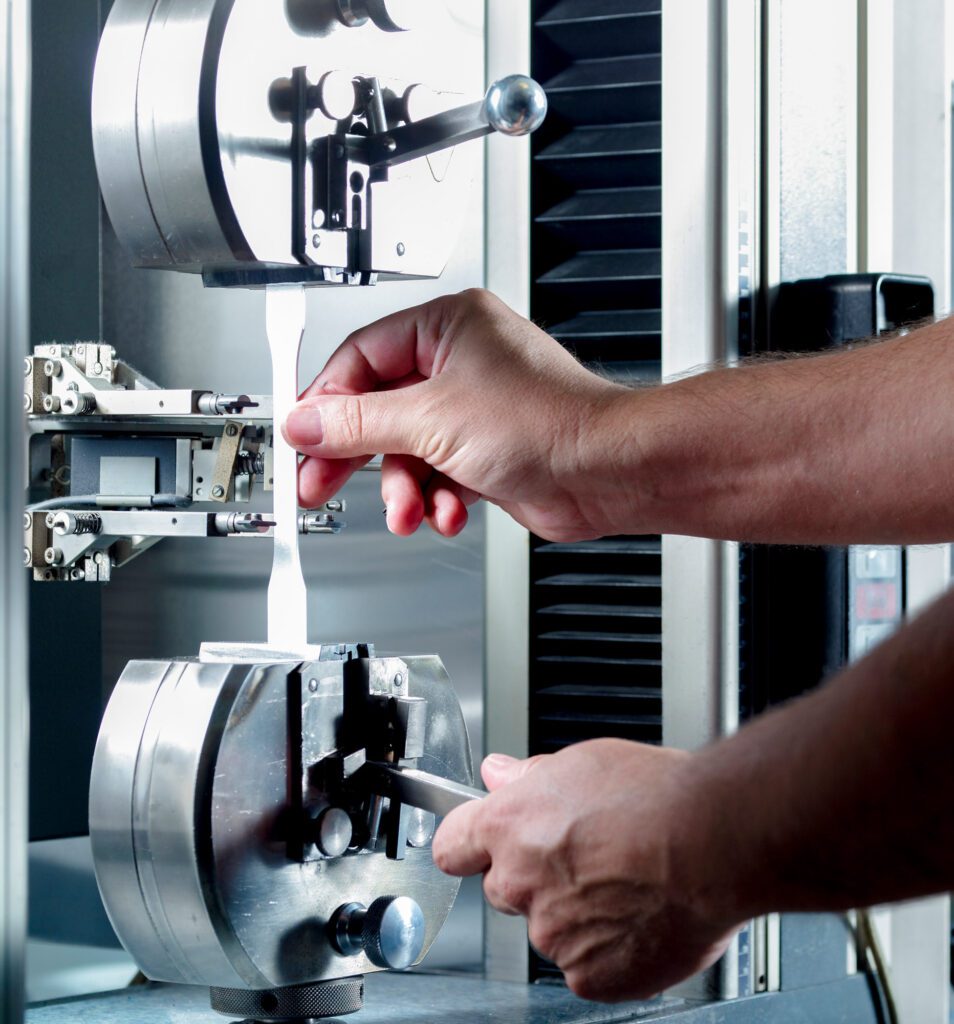
DSC and TGA thermal analysis can determine the thermal stability windows of candidate electrolyte and electrode materials. Mechanical property testing can evaluate the fracture toughness of electrolyte layers under simulated cycling conditions. And accelerated aging can reveal whether interfacial degradation occurs over time — before it is discovered in the field.
Why Independent Testing Matters at This Stage
Solid-state batteries promise enhanced safety, faster charging, and energy densities that could allow for ranges exceeding 350 Wh/kg and 800 Wh/L — but those promises depend entirely on the materials performing as designed. The history of battery development is full of technologies that performed excellently at the laboratory scale and then encountered unexpected failure modes when moved into volume production.
Independent third-party testing plays a critical role at this transition point. An internal QC team has every incentive to confirm that a material meets specification. An independent laboratory has every incentive to find out whether it actually does — and to identify failure modes that internal testing missed.
Strict alignment with international manufacturing standards like ASTM and ISO remains non-negotiable for cross-border industrial trade — and for battery manufacturers supplying automotive OEMs, demonstrating that materials have been tested to recognised standards by an accredited independent laboratory is increasingly a qualification requirement, not just a best practice.

What to Test Before You Scale
If your organisation is evaluating or developing solid-state battery technology, here is a practical starting checklist of materials testing work to complete before committing to scaled production:
- Solid electrolyte composition and phase purity (ICP-MS, XRF, FTIR)
- Cathode active material particle morphology, tap density, and elemental verification
- Electrode-electrolyte interface characterisation (SEM/TEM cross-sections)
- Thermal stability windows for electrolyte and electrode materials (DSC, TGA)
- Mechanical property evaluation of electrolyte films (nanoindentation, fracture toughness)
- Accelerated aging of full-cell and half-cell samples with post-mortem microscopy
This is not a once-before-launch exercise. As chemistries, suppliers, and processing conditions evolve, materials testing needs to be a continuous part of the development and production cycle.
The solid-state battery era is beginning. The manufacturers who get their materials right from the start will be the ones who scale successfully.