
What Is Non-Destructive Testing and When Is It Used? A Complete Guide to Smarter Material Evaluation
In today’s fast-paced industrial landscape, quality, safety, and reliability are more important than ever. Whether manufacturing aerospace components, constructing high-rise buildings, producing medical devices, or developing advanced battery technologies, every material must perform exactly as intended. Even the smallest defect can lead to costly failures, production delays, or safety risks.
This is where non-destructive testing services play a vital role.
Unlike traditional testing methods that may damage or destroy the sample, non-destructive testing (NDT) allows engineers and scientists to inspect materials without affecting their usability. By identifying hidden flaws early, organizations can improve product quality, reduce operational risks, and ensure compliance with strict industry standards.
Let’s explore what non-destructive testing is, when it is used, and why selecting a trusted NDT testing laboratory with advanced Testing Capabilities is essential for long-term success.
Understanding Non-Destructive Testing (NDT)
Non-destructive testing is a collection of inspection techniques used to evaluate the properties, integrity, and performance of materials or components without altering or damaging them.
The primary objective of NDT is to detect defects such as:
- Surface cracks
- Internal voids
- Corrosion
- Material fatigue
- Weld imperfections
- Structural weaknesses
- Manufacturing inconsistencies
Because the tested material remains fully functional after inspection, NDT is ideal for quality assurance during manufacturing, maintenance, and product development.
Professional Non-destructive testing services help organizations make informed decisions while preserving valuable materials and minimizing unnecessary waste.
Why Is Non-Destructive Testing So Important?
Every industry depends on reliable materials. A hidden defect may not be visible to the naked eye but can significantly impact safety and performance.
An experienced NDT testing laboratory provides accurate analysis that helps organizations:
- Improve product reliability
- Enhance workplace safety
- Reduce maintenance costs
- Prevent unexpected equipment failures
- Meet international regulatory requirements
- Increase customer confidence
- Extend equipment lifespan
Instead of replacing components unnecessarily, NDT enables businesses to determine whether a material is still safe for continued use.
Common Types of Non-Destructive Testing
Modern laboratories use various inspection techniques depending on the material, application, and desired results.
Some of the most widely used methods include:
Visual Inspection
The simplest form of NDT involves carefully examining materials for visible defects, surface damage, corrosion, or manufacturing flaws.
Ultrasonic Testing
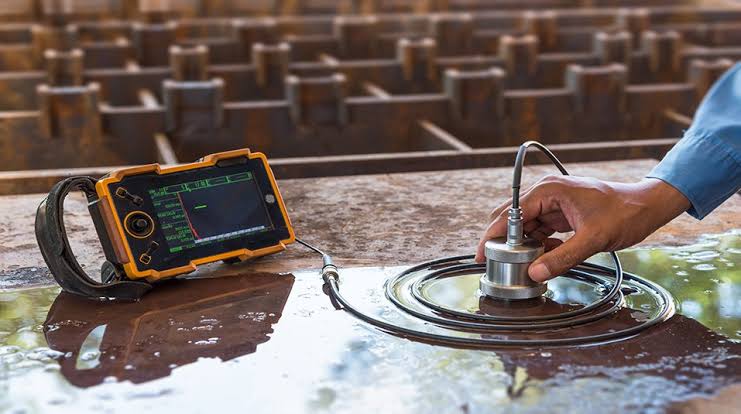
High-frequency sound waves are used to identify internal cracks, voids, and thickness variations within materials.
Radiographic Testing
X-rays or gamma rays create detailed images of a component’s internal structure, making it easier to detect hidden defects.
Magnetic Particle Testing
This method identifies surface and near-surface discontinuities in ferromagnetic materials by applying magnetic fields and specialized particles.
Liquid Penetrant Testing
A colored or fluorescent liquid penetrates surface-breaking defects, making small cracks visible during inspection.
Eddy Current Testing
Electromagnetic induction helps identify surface flaws, corrosion, conductivity changes, and coating thickness without direct contact.
Each technique contributes to a laboratory’s comprehensive Testing Capabilities, allowing customized solutions for different industries.
When Is Non-Destructive Testing Used?
NDT supports virtually every stage of a product’s lifecycle—from research and development to manufacturing and routine maintenance.
During Product Development
Engineers use non-destructive testing services to evaluate prototypes before mass production.
This helps identify design weaknesses early while reducing development costs.
Manufacturing Quality Control
Manufacturers inspect raw materials, finished components, and welded assemblies to verify quality before products reach customers.
Routine inspections improve consistency and reduce costly recalls.
Infrastructure Inspection
Bridges, tunnels, pipelines, and buildings require regular inspections to detect structural deterioration before it becomes dangerous.
NDT enables engineers to monitor aging infrastructure without interrupting operations.
Aerospace Industry
Aircraft components operate under extreme conditions where even microscopic defects can have serious consequences.
Routine inspections help maintain safety while complying with strict aviation standards.
Automotive Manufacturing
Vehicle manufacturers use NDT to inspect engine components, chassis structures, battery systems, and safety-critical parts to ensure long-term performance.
Energy and Power Generation
Power plants, oil refineries, renewable energy facilities, and pipelines rely on continuous inspections to detect corrosion, fatigue, and structural damage before failures occur.
Healthcare and Medical Devices
Medical equipment manufacturers depend on advanced material testing to ensure product safety, durability, and regulatory compliance.
The Role of an Advanced NDT Testing Laboratory
Choosing a qualified NDT testing laboratory means more than simply running inspections.
Modern laboratories combine scientific expertise with advanced instrumentation to deliver reliable, data-driven insights.
An experienced laboratory offers:
- Highly trained scientists and technical specialists
- Advanced analytical equipment
- Strict quality assurance procedures
- International testing standards
- Confidential project handling
- Customized research solutions
- Detailed reporting and interpretation
Working with a trusted laboratory ensures every project benefits from precision, consistency, and technical excellence.
Comprehensive Testing Capabilities Make the Difference
Today’s industries require far more than basic inspections.
Leading laboratories offer integrated Testing Capabilities that support research, product development, failure analysis, and regulatory compliance.
These services often include:
- Advanced microscopy
- Chemical and environmental analysis
- Battery materials analysis
- Contaminant identification
- Material characterization
- Research methodology development
- Scientific data analysis
- Contract research support
By combining multiple analytical techniques under one roof, organizations gain a deeper understanding of material performance while accelerating innovation.
Benefits of Professional Non-Destructive Testing Services
Partnering with experienced professionals delivers measurable advantages across every industry.
Some key benefits include:
- Early detection of hidden defects
- Reduced production downtime
- Improved product quality
- Lower repair and replacement costs
- Better regulatory compliance
- Increased operational efficiency
- Enhanced customer trust
- Longer equipment service life
Most importantly, NDT helps organizations make confident decisions based on accurate scientific evidence rather than assumptions.
Why Genuine Testing Is Your Trusted Research Partner
At Genuine Testing, scientific excellence meets practical innovation.
With decades of experience in material testing and contract research, Genuine Testing provides advanced laboratory solutions that help organizations improve product performance, maintain compliance, and accelerate innovation.
The laboratory combines cutting-edge technology, experienced scientists, and comprehensive Testing Capabilities to deliver reliable, transparent, and actionable results across industries including aerospace, automotive, construction, energy, healthcare, and advanced materials.
From material characterization and contaminant identification to research design and data interpretation, every project is handled with precision, confidentiality, and a commitment to scientific excellence.
Conclusion
As industries continue to demand safer products, higher quality standards, and faster innovation, non-destructive testing has become an indispensable part of modern material evaluation.
Professional non-destructive testing services help organizations identify defects before they become costly problems, while an experienced NDT testing laboratory provides the scientific expertise needed to support confident decision-making. Combined with comprehensive Testing Capabilities, these services enable businesses to improve safety, ensure compliance, optimize product performance, and stay competitive in an increasingly demanding marketplace.
Whether you’re developing next-generation materials, validating manufacturing quality, or supporting complex research initiatives, investing in advanced non-destructive testing is a smart step toward long-term success.