
Composite Testing Explained: Advanced Methods, Mechanical Property Testing, and Chemical Compatibility for Reliable Material Performance
Composite materials have transformed modern engineering by combining the strengths of different materials into lightweight, durable, and high-performance solutions. From aerospace components and automotive structures to construction systems, energy technologies, medical products, and advanced manufacturing, composites are increasingly selected when conventional materials cannot meet demanding performance requirements.
However, developing or selecting a composite is only the beginning. Composite materials evaluation is essential for understanding how a material behaves under mechanical stress, environmental exposure, chemical contact, and real-world operating conditions. Proper testing provides the evidence needed to verify quality, improve product design, meet industry requirements, and reduce the risk of premature failure.
At Genuine Testing, advanced laboratory capabilities, scientific expertise, and rigorous methodologies help organizations obtain dependable material data for research, development, quality control, and regulatory needs.
What Is Composite Materials Evaluation?
Composite materials evaluation involves a systematic examination of a composite’s physical, chemical, mechanical, and structural characteristics. Unlike a single-component material, a composite typically contains two or more constituents, such as a reinforcing fiber and a polymer matrix. The interaction between these components can significantly influence the final material’s performance.
Testing helps researchers and manufacturers determine whether a composite is suitable for its intended application. It can also reveal defects, inconsistencies, contamination, degradation, or weaknesses that may not be visible through basic inspection.
A comprehensive evaluation may include microscopy, chemical analysis, mechanical testing, environmental exposure studies, and specialized performance assessments. Combining these techniques gives engineers a clearer understanding of how the material is likely to perform throughout its service life.
Why Composite Testing Matters
A composite can appear strong and reliable while still containing microscopic flaws or weaknesses that could become serious under demanding conditions. Testing provides objective data instead of relying solely on theoretical calculations or visual inspection.
Reliable testing can help organizations:
- Verify material quality and consistency
- Identify manufacturing defects
- Compare different formulations or reinforcement systems
- Optimize product designs
- Investigate material failures
- Assess suitability for demanding environments
- Support research and development
- Generate data for quality and compliance requirements
- Improve product safety and reliability
For industries where component failure can have significant financial or safety consequences, accurate testing is not simply a research step—it is an important part of responsible product development.
Key Methods Used in Composite Materials Evaluation
There is no single test capable of describing every characteristic of a composite. Instead, laboratories select methods based on the material, application, and questions that need to be answered.
1. Microscopy and Structural Examination
Microscopy provides detailed information about a composite’s internal structure. High-resolution imaging can reveal fiber distribution, matrix conditions, voids, cracks, delamination, inclusions, and other microscopic features.
This information can be particularly valuable when investigating unexpected performance issues. For example, poor fiber-matrix bonding or excessive void content may help explain why a component fails earlier than anticipated.
Microscopy can therefore connect microscopic observations with measurable material performance.
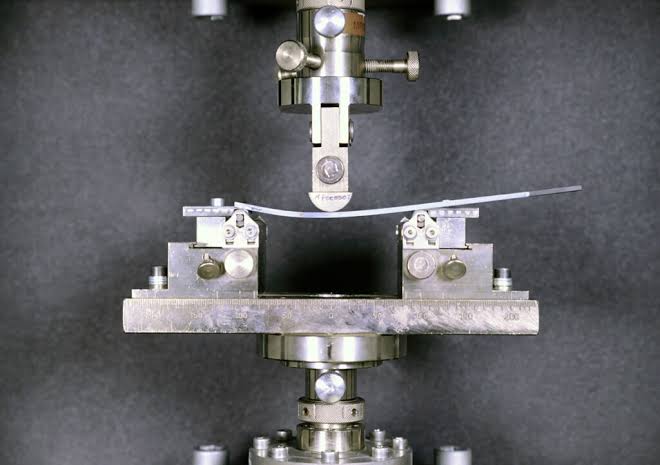
2. Mechanical Property Testing
Mechanical property testing is one of the most important parts of composite evaluation. Engineers need to understand how a material responds when subjected to forces encountered during actual use.
Depending on the application, testing may examine characteristics such as tensile strength, stiffness, compression performance, flexural behavior, impact resistance, and other mechanical properties.
Mechanical testing can answer critical questions:
- How much load can the composite withstand?
- How does it deform under stress?
- Does performance change after repeated loading?
- How does the material respond to sudden impact?
- Are different material formulations producing measurable performance differences?
The results can guide material selection, structural design, manufacturing improvements, and product validation.
3. Chemical Compatibility Testing
Mechanical strength alone does not guarantee long-term reliability. A composite may perform exceptionally well under laboratory loading but deteriorate when exposed to chemicals, solvents, fuels, cleaning agents, moisture, or other substances.
Chemical Compatibility testing examines how a material interacts with specific chemical environments. Depending on the application, researchers may evaluate changes in appearance, mass, dimensions, mechanical properties, surface condition, or structural integrity following exposure.
This type of testing is especially valuable for components used in industrial, automotive, aerospace, healthcare, energy, and chemical-processing environments.
Understanding chemical compatibility before production can help prevent unexpected swelling, cracking, weakening, discoloration, corrosion-related effects, or other forms of material degradation.
4. Chemical and Environmental Analysis
Composites can also be evaluated to better understand their composition and response to environmental conditions. Chemical analysis can help identify constituent materials, contaminants, unexpected compounds, or changes caused by exposure.
Environmental analysis may be used to investigate how factors such as humidity, temperature, chemicals, or other conditions affect material performance.
These investigations can support product development while helping organizations understand potential risks associated with long-term use.
5. Contaminant Identification
Even small amounts of unwanted material can influence composite performance. Contamination may occur during manufacturing, handling, processing, storage, or service.
Contaminant identification techniques help determine what an unexpected substance is and potentially where it originated. This can be particularly useful during failure investigations, quality-control assessments, and root-cause analysis.
Identifying contamination early can help manufacturers correct production processes and prevent recurring material problems.
Connecting Test Results to Real-World Performance
The true value of composite testing is not simply producing numbers. The objective is to transform laboratory observations into useful scientific insight.
For example, mechanical property testing might reveal a reduction in strength after chemical exposure. Microscopy could then identify cracking or changes in the material’s internal structure. Chemical analysis may provide additional information about the source of degradation.
When these results are interpreted together, researchers can develop a more complete understanding of why the material behaves differently and what changes could improve its performance.
This integrated approach is particularly valuable for research and development projects where material behavior is still being established.
A Scientific Approach from Sample to Solution
Effective testing begins before a sample reaches the laboratory. The testing strategy should be aligned with the project’s objectives, expected operating conditions, material characteristics, and required outcomes.
At Genuine Testing, projects can follow a structured process that includes understanding client requirements, developing an appropriate methodology, executing laboratory procedures under controlled conditions, and interpreting the resulting data.
Advanced laboratory instrumentation, experienced scientific professionals, rigorous methodologies, and quality-focused processes help ensure that testing generates reliable and actionable information.
Supporting Better Material Decisions
Whether an organization is developing a new composite, investigating a failure, comparing materials, or validating an existing product, carefully selected testing methods can significantly improve decision-making.
Composite materials evaluation, mechanical property testing, and Chemical Compatibility studies each provide valuable information. Together, they can create a much more comprehensive picture of material performance.
With scientific testing, organizations can move beyond assumptions and make decisions based on measurable evidence. That can support stronger designs, more dependable products, improved manufacturing processes, and greater confidence before a product reaches the market.
Choose Testing That Moves Research Forward
Composite materials continue to evolve, and their applications are becoming increasingly demanding. As performance expectations rise, comprehensive laboratory evaluation becomes essential for understanding how these sophisticated materials behave.
Genuine Testing combines advanced laboratory capabilities with scientific expertise to support material testing, research, analysis, and product-development objectives. From detailed structural examination to mechanical property testing, chemical analysis, contaminant identification, and Chemical Compatibility assessment, the right testing strategy can turn complex material questions into actionable scientific answers.
When material performance matters, accurate testing provides more than a report—it provides the knowledge needed to develop, validate, improve, and confidently advance the next generation of products.